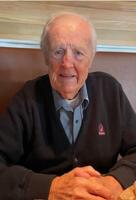

London Gore believes in the power of prayer, even if it takes more than six decades to be answered.
That’s what the 87-year-old Shallotte resident and World War II veteran had been doing all those years in hopes of finding the family of Sgt. Michael Dicky, his Army tank commander and good friend who was killed before Gore’s eyes during the Normandy campaign on Aug. 13, 1944.
Credit Charlotte resident and World War II buff Jerry Evers for providing assistance.
Recently, Evers’ childhood friend, Chet Hales of Ocean Isle Beach, invited him to come down and meet Gore, who along with Hales attends Jennies Branch Baptist Church.
“After meeting Mr. Gore and hearing his story, I realized there was more to be done,” Evers wrote in a recent account of Gore’s wartime experience.
SERGEANT LOST
It was two months after the D-Day landings when Gore, a native of Ash and gunner in the newly mechanized 71st Field Artillery Battalion in the 5th Armored Division, lost his sergeant.
That horrendous day in the French countryside, according to Evers’ account, their crew had been ordered to rendezvous forward when they were held up by German strong points. They had found their infantry, with no Germans in sight.
“Sgt. Dicky got out of the tank to talk with some officers who were to provide details of our mission,” Gore told Evers. “The Germans suddenly opened up with a mortar barrage directly on our tank. Sgt. Dicky and the officers were all hit. I wanted to get out to help him but that’s when we were ordered out of the area. I never got to see him again. He died in that French hedgerow.”
Gore later wrote to Dicky’s wife but never got a response.
FAMILY FOUND
Fast-forward 66 years later.
On a recent business trip to Paris, Evers, a flight attendant for US Airways, had some free time to visit Suresnes American Cemetery, where a superintendent confirmed the casualty status of Dicky. Digging deeper, Evers, who speaks French as his mother is from France, learned Dicky had a brother named John, also a World War II veteran, who is still living. Evers forwarded the information to Gore, who was excited to finally be able to contact Dicky’s family.
Evers received a grateful call about a week later from Gore, who thanked him for locating Sgt. Dicky’s grave as well as his family.
“While I had really just been trying to understand more about Mr. Gore’s wartime experience, I learned later that this was something more than that to him,” Evers wrote. “He conveyed to me that it had been his prayer for nearly 70 years that he’d be able to one day speak to his friend’s family. It really meant more to him than I’d ever imagined.”
“I wish you could have just seen Mr. London when I told him somebody in [Dicky’s] family survived,” Hales said.
Gore, he said, had tears in his eyes when he told their Sunday school class at Jennies Branch his decades-long prayers had been answered.
Hales said his role in all this is just as the middleman. Evers, he said, did all the legwork.
“I think a lot of Mr. London, and he does so much with the veterans,” Hales said. “His mind is very sharp.”
GOING STRONG
Gore writes lots of “pomes,” as he calls them, and also plays guitar. He’s a regular at the weekly Friday-night bluegrass jams at Shallotte Senior Center, where he plays pool during the week.
“We hit it off right off the bat,” Evers said. “He’s a real pleasurable individual to talk to.”
Helping Gore find his wartime buddy’s family, he said, “was the very least I could do for somebody like that.”
It’s a small way, he said, to “give back to those guys that sacrifice so much.”
If not for them, “maybe my mom wouldn’t be here,” Evers said. “I’m glad to help in any way.”
Evers’ efforts were “a big surprise to me,” Gore said recently during an interview at the Shallotte Villas home he shares with his wife, Mary.
This particular day, Gore had just returned home from shooting another winning game of pool with the guys at Shallotte Senior Center.
“I’ve already beat ’em all at pool and come back home,” he said, showing off his Civil Air Patrol jacket and medals he finally received two years ago.
Last month at church, he said, Hales read his World War II story about finding Dicky’s family to the congregation at Jennies Branch and it drew a standing ovation.
‘AM I GOING TO MAKE IT?’
Gore grew up poor working on his dad’s tobacco farm from an early age. He joined the army at an early age, too.
“I wanted to travel and, boy, did I,” Gore said. “One thing I loved was horses. They had an opening in the horse-drawn artillery, so that’s where I went.”
Eventually, he became part of General Patton’s Ghost Division.
“And we was sent behind the lines to get behind the Germans,” Gore recalled. “We had it rough.”
To this day, he said, “I can never figure out how I made it—a hundred and 61 days frontline in a Sherman tank. I just kept telling myself, ‘am I going to make it?’”
He also could sleep in the midst of turmoil.
“My lieutenant told me at one time, he said, ‘You’re the damnedest fella I’ve ever met,’” Gore recalled. “He said ‘when things get really tough, you want to take a nap.’ I’d be so tired. We’d just go and go and go. And I’d have to catch a nap even traveling.”
“He come out without a scratch on him,” Mary Gore said of her husband. “I said, ‘You’d better thank the good Lord every day.’”
After the war, Gore worked initially as a taxi driver in Charlotte and later for years as a tree surgeon in Sumter, S.C., where he also bought and restored a World War II plane he flew for years between the Carolinas.
“That was my transportation from Sumter to Shallotte—back and forth,” Gore said. “I was landing before they even had the Odell Airport.”
BACK IN BRUNSWICK
Among Gore’s portfolio of “pomes” he’s written are tributes to his wife of more than 50 years. The house he grew up in still stands on N.C. 130, a wooden frame one with a rusty roof next to Mount Zion Baptist Church.
He and Mary have been married for the past seven years, “but we have known each other and been friends since 1968,” Mary said. “His wife passed away, and my husband passed away.”
Gore appreciated Hales’ recent tribute to him at church.
“My problem was I couldn’t understand him,” said Gore, who wears a hearing aid. “I knew what he was doing, ‘cause at the end of it he said, ‘Would the real Mr. London Gore stand up?’
“I was really surprised,” Gore said, chuckling. “I’m telling you. And when I stood up, everybody in that church stood up.”
Add new comment
Read and share your thoughts on this story