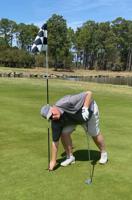

Tim Cate has designed yet anther fabulous golf course in Brunswick County. Cape Fear National in Leland is slated to open in October and I can hardly wait.
On Friday morning, I had the privilege of riding around Cape Fear National with Tim as my guide. He has designed many of the top courses in the upper Grand Strand, including Thistle Golf Club, Panther’s Run, Tiger’s Eye, Leopard’s Chase and The Players Club. Tiger’s Eye is listed on Golf Digest’s top-100 public courses in the United States. When Leopard’s Chase opened in 2007, it became “Best New Course” by Golf Digest and Golf Magazine.
This is heady country for a local guy and Brunswick County should be proud of him. Right now, Tim Cate is on the short list of anyone seeking to build a premier golf facility. Now after previewing the course, Cape Fear National may become one of those “must play” courses with framed award certificates hanging on the walls of the pro shop.
Tim has a unique concept in his designs. His courses seem to fit into the land, to nestle there like a living work of art. He uses various natural grasses, wildflowers, coquina rocks and water (lots of water) to outline his courses.
“The coquina rocks, which surround the ponds and create waterfalls, are from the North Carolina coast. The grasses and wildflowers are native to this area. There are no gimmicks to my courses,” he explained as we drove past flowers, ponds and gentle waterfalls.
Tim moved a mountain of dirt to create Cape Fear National. If you look at a topographical map of the course, it appears to be divided equally between golf course, wetlands, water and forest. The holes sprawl out over a vast area of land, with curved wooden bridges connecting landing areas or providing paths between greens and tees. There are changes of elevation everywhere.
“We started with a relatively flat piece of land,” Tim explained. “We dug a lot of ponds and used that dirt to create the mounding, elevated tees and greens and undulating fairways.”
How long does it take to design a golf course, once the golf course architect has the aerial photos and the topographical maps? This is raw land, and the designer must coax a golf course out of it, using some of what nature has given him, then adding features of his own.
“It took four to six months to do the basic design work,” Tim explained. “Then, when the machines started to dig and the course began to take shape, I was here daily, changing it in subtle ways, improving it.”
A golf course architect works like a regular architect and produces a series of blueprints for his course, hole by hole, area by area. He decides which trees to keep, whether to re-route a creek, where to dig ponds and where to mound the dirt that comes out of those ponds. He places bridges where they are needed. It’s like sculpting, only he uses the land.
“While under construction, the plan often changes,” Tim explained. “I don’t like to be too rigid or to set my design in stone, because the land does not always turn out like I expect. I need the freedom to make changes as the course is built. I don’t want to get to the end of the project and say, ‘I wish I had done that’ or ‘I shouldn’t have done this.’ Once the course is done and the grass is in, it’s hard to make changes, but you can do it easily during the construction phase.”
Tim has a generalist’s view of golf and tries to provide a course for all levels of players, although a golf course is designed from the back tees forward. Fairways narrow at certain areas to keep the long-ball hitters from blasting away with huge shots that will get them to the green in two on a par-5. While Tim provides challenges for the professional or the scratch player, he is kind to the higher handicapers. Often the forward tees take a pond or wetlands completely out of play.
“Golfers need to analyze the risk and reward factor, think about the trouble they may find if they try a long shot and miss,” Tim said. “On the other hand, I like to leave an escape route for the older gentlemen, ladies or the beginning golfers. If a golfer cannot hit over a large water hazard, I give him an alternative.
“If a senior citizen has been playing golf his whole life, he should be able to continue playing even though he can no longer hit it as far. As people age, they can move to forward to the tees that are more comfortable. I don’t build impossible golf holes. I never give the forward tees more than 100 yards on a par-3 hole, but to escape the lake that everyone else has to carry, the red-tee player must now hit a high shot over bunkers. Basically, it’s the same game with different challenges.”
Another factor in Tim’s philosophy of design is the beauty of his courses. On the sides of Cape Fear National, the golfer sees beautiful cypress swamps with lily pads. He sees forests, lakes, waterfalls, wildflowers and swaying tall grasses.
“I hope that a golfer who is having a less-than-perfect round will say, ‘This was not my best day, but I loved the course.’ That’s good design.”
Cape Fear National is nearly done. The fairways are like velvet carpets, the bent grass greens are smooth as silk. Most of the bunkers are filled with sand; the waste bunkers are ready for the sand, which will be arriving in the next few weeks.
If all goes well, Cape Feat National will open in October.
GOLF GAB GROANER
Golf Q & A:
Q: How does golf resemble fishing?
A: They both encourage tall tales.
Q: What is the golfer’s least favorite drink?
A: Slice.
Q: What’s the difference between a whiff and a practice swing?
A: Nobody curses after a practice swing.
Q: How can a golfer improve his score?
A: Take lessons, practice a lot and start cheating!
Elsa Bonstein is a golf columnist for the Beacon. Reach her at elanbon@atmc.net.
Add new comment
Read and share your thoughts on this story