
Two weeks ago, I was graced with an abundance of spiritual opportunities. I eagerly accepted the gift, despite the fact both invitations demanded an early departure from my somewhat leisurely Friday and Saturday schedules.
At the time, I doubt I considered the offerings to be a call from God. I was simply responding to the graciousness of others. Upon reflection, the response was clearly not the whole story.
The first, “Heart, Mind and Soul,” was a presentation by Lower Cape Fear Hospice. It included important information for the times when illness strikes, and so much more. The second, “Grand Strand Women’s Day,” might well have been similarly titled because it attended to the present day status of spiritual health.
Both focused on the reality of God and God’s goodness, as experienced in the human condition. Neither would likely have considered the other to be under the same umbrella: spirituality.
At first blush, one might question my assessment, but Hospice is all about helping people to live in the face of terminal illness and subsequent death.
When my husband was chaplain and bereavement counselor for Lower Cape Fear Hospice, he remarked his job was to help people die well. To do that, they were assisted in living well.
Spirituality addresses an identical process. Both agree there is a need to recognize we are not in control of our life but are responsible for the gift of life.
Both proclaim God’s essential presence in the midst of it all. Both recognized the need for laughter to ease pain, to pave the way, to give joy to sorrow and change tears of heavy mourning to tears of happy memories.
As I listened to the various speakers, I was struck with our human need to analyze before we can synthesize, our need to separate parts before we put together the whole, our need to focus on one or another aspect of God before we can really appreciate the magnificence of the God who is beyond all understanding.
Upon reflection, it dawned on me the Hospice presentation focused on the immanent God, Emmanuel, the God who lives within us.
This God is more present and near than our own breath and heartbeat. This God demands and commands us to learn about divinity as we see it in others.
This God advocates our listening deeply to each other, our avoidance of judgment, our encouragement and empowerment of those less able than we, our respect for each other’s rituals and ways of entering God’s presence.
To work with and minister to patients with dementia is to attain a lucid picture of God’s immanence. At least, that is what I learned as I listened to and participated in the talk given by Melanie Bunn, an Alzheimer’s Association training specialist.
As she portrayed the various stages of dementia in graphic role-playing, those in attendance laughed—and inwardly cried. We laughed at our own foibles and cried with the loss that became more real than we could have imagined. We learned the limitations of logic and the power of presence.
Interestingly, it is also true prayer breaks through logic with the power of God’s imminent presence.
In a sense, we are all experiencing the various stages of spiritual dementia. It does no good to argue a point when we are not able to hear it. Words are useless when they have lost meaning.
What is stored in the deep memory banks of our spirit will emerge at the strangest moments and in the most unusual ways. When all words have disappeared, the emotion of the event remains to be recalled, reconciled, and remembered.
We take cues from each other and learn our way as we go. We also learn the way similarly. We discover in our spiritual dementia we are the prayer. We are God’s prayer in the world.
Melanie named the stages of dementia from earliest to most severe. She used jewels to describe the stages: diamonds, rigid, stubborn, unchangeable with the need to retain control; emeralds who are busily looking for meaning in the meaninglessness of their lives; ambers who have slowed down because they can no longer see whole things but only parts; rubies who are on automatic pilot; and lastly, pearls whose treasure is hidden deep within an exterior that is now only roughly human.
I could see myself in each of those gems, not physically but spiritually. Seeing, I need a God who is near, very near.
Day two brought me to another treasure, the awesome God of the heavens above. Five hundred women gathered in the sanctuary but the hymns reverberated as one voice.
I did not sing. I could not sing. My voice might have drowned out the divine melody drumming its message into my very being. This was the day I knew my spiritual dementia. This was the day the transcendent God visited me to let me know God’s thoughts and ways are far beyond mine.
Humor again took hold to soften the blow of human insufficiency and to remind us we are good enough for God. We can, and should, stand nakedly before the mirrors of our lives and shout, “Ta Da!”
At the same time, there are profound questions to be posed and equally profound responses to be researched and reported. Where have we come from? Where are we going? How do I name God?
The questions will lead us to the God who gives us life, always and in all ways. This is the God who allows us to feel deprivation but also provides.
This is the God who waits for our prayer and plea but is never absent in our silence. This is the provident God who blesses us because God is good, not because we have earned or deserved the graciousness. This is the God who sends us back into difficult situations so that we might learn that God alone gives us life.
God alone is love. God alone saves us from our very selves.
I looked around the sanctuary, let my eyes gaze upon the women present there. They were young and old, large and small, African-American and Caucasian.
Some sat in wheelchairs. Others wobbled with physical disability. Many may have been in pain or carrying a heavy burden, but everyone was smiling, and I felt the pulsating spirit of the transcendent God.
With their arms raised high in praise, faces tilted to the sky, these women in this place, at this time, knew one thing: God is an awesome God.
Each day was a blessing. Together they made an incredible weekend with divinity. With spirituality, one size doesn’t fit all. But, unless it is tried, we’ll never know what size fits us.
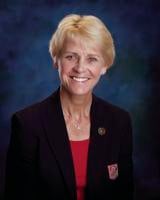
Fran Salone-Pelletier has a master's degree in theology and is the author of, AWAKENING TO GOD: The Sunday Readings in Our Lives [a trilogy of scriptural meditations], leadchaplain at Brunswick Community Hospital, religious educator, retreat leader and lecturer.
Add new comment
Read and share your thoughts on this story